The DPRI Method: Transforming PR into Measurable Business Outcomes
Key Takeaways
- PR measurement must move beyond vanity metrics to trackable business outcomes like domain authority, lead generation, and organic traffic.
- The rise of AI search engines fundamentally changes PR: earned media is now the primary data source shaping a brand's narrative within AI answers.
- The DPRI Method provides a boardroom-ready dashboard to measure 5 key pillars: AI Visibility, Digital Authority, Narrative Consistency, Sentiment, and Business Outcomes.
- While DPRI maps digital ROI, it respects that long-term goodwill and human relationships remain an unmeasurable, yet vital, foundation of PR.
What DPRI Measures - and What It Doesn't
PR is far more than measurement. Relationship capital, stakeholder trust, editorial goodwill, crisis judgement, and brand narrative - these are the irreducible human dimensions of public relations that no framework can fully quantify. PR and communications measurement must move beyond purely content analysis, and practitioners must demonstrate outtakes and outcomes as well as the organisational impact of their work.
The DPRI Method (Digital Public Relations Integration) doesn't claim to measure all of PR. It focuses specifically on the outcomes where digital channels, AI systems, and changing content consumption patterns have created new, trackable pathways between PR activity and business results. These are outcomes that weren't measurable in the traditional PR era - and they're becoming more important every year.
Why PR Measurement Is at a Breaking Point
The role of communications has expanded dramatically over the past five years. What was once a function focused on media relations and press releases is now expected to influence brand reputation, support revenue goals, manage crises in real time, and increasingly, shape how AI systems perceive and describe the brand.
Yet the measurement gap remains wide. Only 34% of PR teams have the tools, frameworks, and data strategies to meet this demand. The cost is real - without reliable data, communications teams remain stuck in reactive mode, unable to anticipate narratives or connect their work to business outcomes.
If comms wants to sit at the top table, it must be focused on measuring business outcomes. If it's still showing vanity metrics such as AVE, it does not deserve a seat. If it's demonstrating reputational change, policy influence, shifts in brand awareness and demand generation, then the conversations are strategic and merit a place in the boardroom.
The DPRI Method is designed precisely for that boardroom conversation.
The AI Disruption That Changes Everything
The single biggest structural shift driving DPRI's relevance is the rise of AI-powered search and answer engines. This isn't a future trend - it's already reshaping how stakeholders find information about brands.
When Pew Research Centre analysed 68,879 Google searches in March 2025, users who encountered an AI-generated summary clicked on a traditional result just 8% of the time. Those who didn't see a summary clicked nearly twice as often. A quarter of users who saw an AI summary ended their session without clicking on anything at all.
This means the old metric of "website referral traffic from PR" is increasingly insufficient. The discovery journey now happens inside AI answers - and those answers are built on the media coverage, structured content, and entity authority that PR creates.
McKinsey's AI Discovery Survey found that a brand's own website accounts for only 5 to 10% of the sources AI search platforms reference. The other 90% comes from publishers, user-generated content, affiliate sites, and review platforms.
This is PR territory. Every media placement, every expert quote, every earned mention is now raw material that AI systems use to construct the brand narrative that stakeholders encounter.
The Core Formula
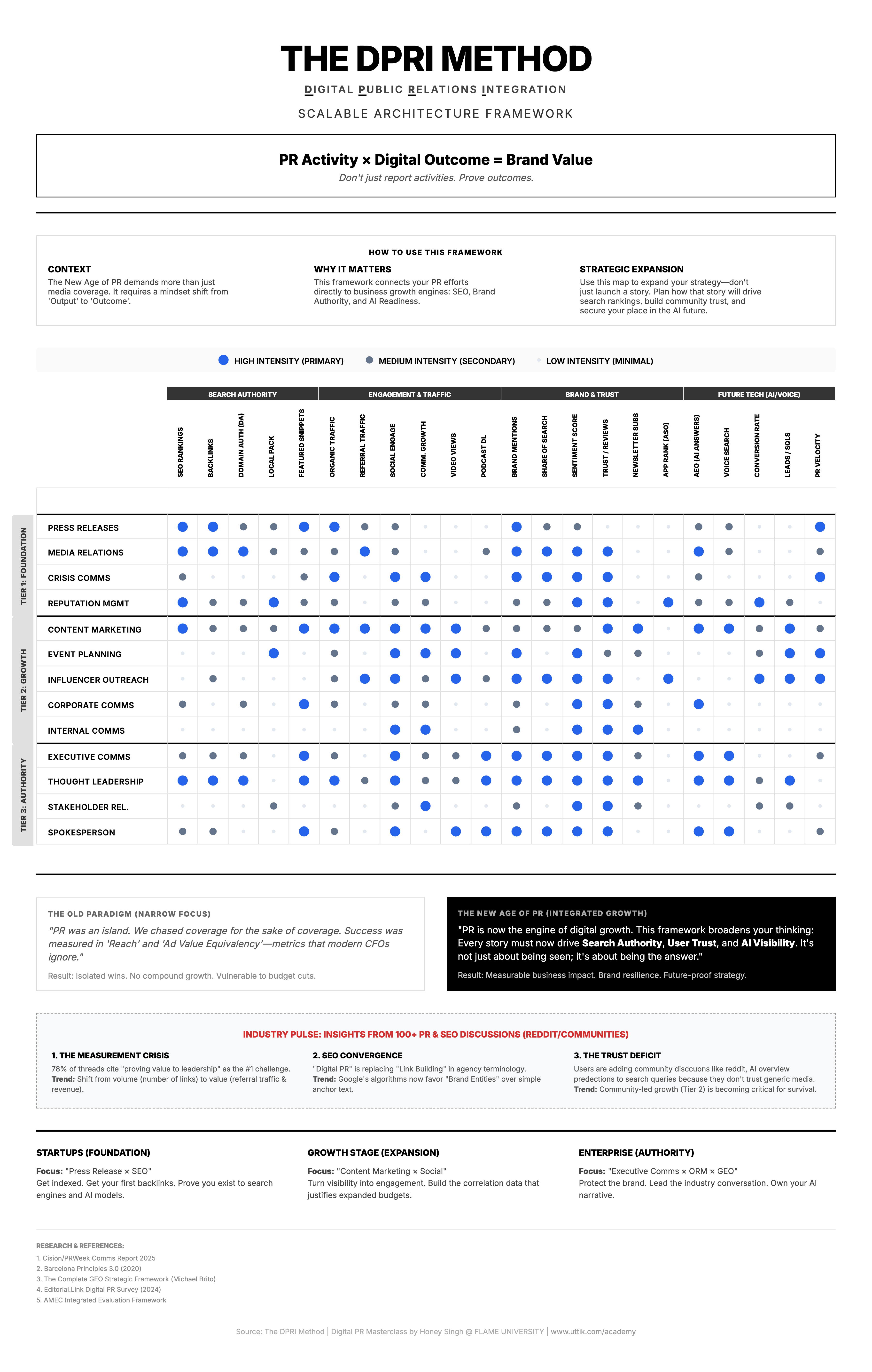
The 3 Strategic Tiers
Foundation
Focus: Startups
Establish existence. Get indexed by search engines. Secure first backlinks. Prove to Google and AI models that you are a real entity.
Growth
Focus: Scale-ups
Turn visibility into engagement. Drive referral traffic. Build social proof and community. Create correlation data to justify budget expansion.
Authority
Focus: Enterprise
Dominate the narrative. Executive thought leadership. Reputation management. Own the AI answer (AEO) for your industry category.
The Five Measurable Outcome Pillars of DPRI
The DPRI framework maps every PR activity across five critical digital dimensions:
How to Use the DPRI Method Tool
Use the interactive tool below to build your PR integration strategy:
- Select an Objective: Choose what you want to achieve (e.g., "Build Search Authority").
- Identify Activities: The tool highlights which PR activities map to that objective.
- Track Outcomes: See exactly which digital metrics you should be measuring.
- Export Plan: Use the data to create your campaign report or strategy document.
The DPRI Correlations Framework
The core of the DPRI Method is a systematic catalog of how PR work produces digital results: 11 PR Activities x 22 Digital Marketing Terms x Examples Each = Multiple Correlations
View Full Screen / Print Infographic ↗
The DPRI Measurement Dashboard (Core KPIs)
| Metric | What it tracks | Business connection |
|---|---|---|
| AI shelf share | Brand mention rate in LLM answers | Discovery, consideration |
| Domain authority gain | PA/DA movement from earned coverage | Organic traffic, SEO |
| Narrative alignment score | Message accuracy in earned media | Brand clarity, trust |
| Sentiment index (AI + human) | Tone of AI-generated brand descriptions | Purchase confidence |
| Referral traffic from PR | UTM-tracked visits from placements | Lead generation |
| Share of voice (AI) | Brand presence vs competitors in AI answers | Competitive positioning |
| Citation velocity | Rate of new authoritative references | Long-term reputation equity |
What DPRI Cannot Measure
DPRI does not measure:
- The long-term goodwill created by a decade of relationship-based media engagement
- The qualitative value of being off the record trusted by a journalist
- The intangible brand equity built through event PR, community PR, or sustained sponsorship
- The counterfactual: crises that didn't happen because of good PR
There is no one-size-fits-all measurement framework. Working with the client, the approach must be applied in a way that makes sense to their business. The shift must be made one step at a time, to implement valid measures that more accurately assess the value of PR to the business as part of the integrated mix of marketing communications efforts.
DPRI is most powerful when used alongside - not instead of - qualitative reputation assessment, media relationship audits, and executive stakeholder surveys. Together, they give leadership a complete picture: the measurable business impact, and the unmeasurable strategic value.
The Bottom Line
The DPRI Method does not try to put a number on everything that makes PR valuable. It is, instead, a framework built for the specific outcomes that have become measurable and strategically critical in the age of AI-powered information consumption.
DPRI answers the ultimate ROI question - not for all of PR, but for the growing portion where digital and AI have created a clear, traceable line between a PR decision made in a strategy meeting and a business outcome visible in a dashboard. That line is the foundation of modern, accountable communications leadership.
Practitioner's Tip: Outcome Mapping
Stop reporting on 'activities' and start reporting on 'outcomes'. Instead of saying "We sent 50 pitches," say "Our media relations strategy produced 5 high-authority backlinks, improving our Branded Search Volume by 12%."
Deep Dive: Study Articles & Case Studies
-
AMEC Integrated Evaluation Framework
The global industry standard for measurement. Understand how the DPRI Method operationalizes these high-level principles.
-
The Evolution of PESO: Strategic Integration
A look at how the PESO model has evolved to meet the demands of a data-driven marketing ecosystem.
-
Ethics in Measurement and Attribution
Maintaining integrity while tracking digital outcomes and attributing value to PR activities.